
Research Visit to Spain: The Role of Narratives in Child Sexual Abuse Fiction
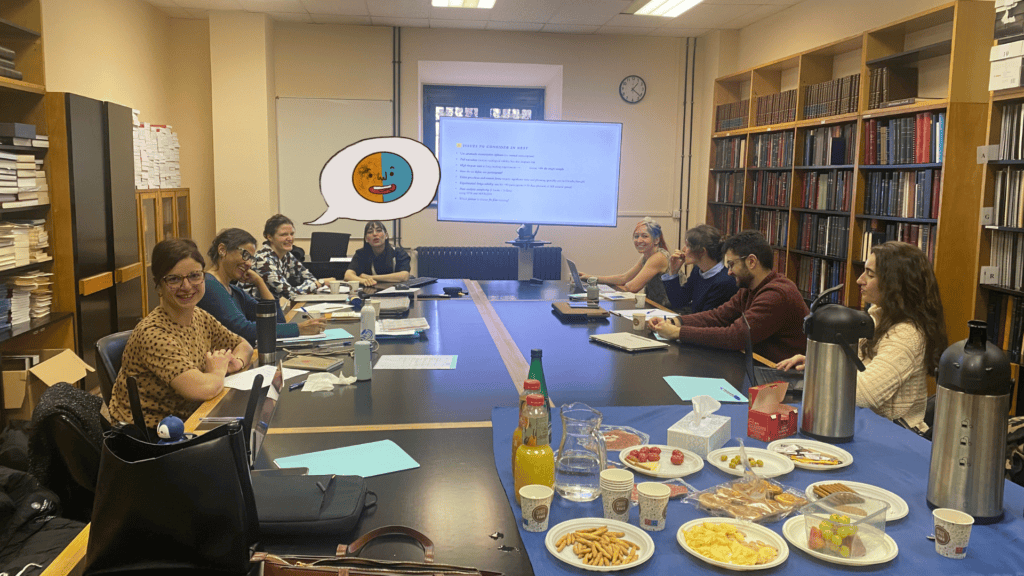
CSAReps’ postdoctoral researcher, Victoria Pöhls is a part of the advisory board for the “Narrative Engagement for Social Anxiety Therapies” (NEST) project, together with Emily Troscianko and Melina Ghassemi Nejad (who could not be present at the meeting).
On March 9th until 13th, 2026, Victoria travelled to Oviedo, Spain to discuss the theoretical concept of Storyworld Possible Selves (SPS) with the NEST team, which can be defined as “imagings of the self in storyworlds” (Martinez, 2014). She presented how she has used it in the past in empirical studies of audience responses, studying the connection between SPSs and prosocial effects.
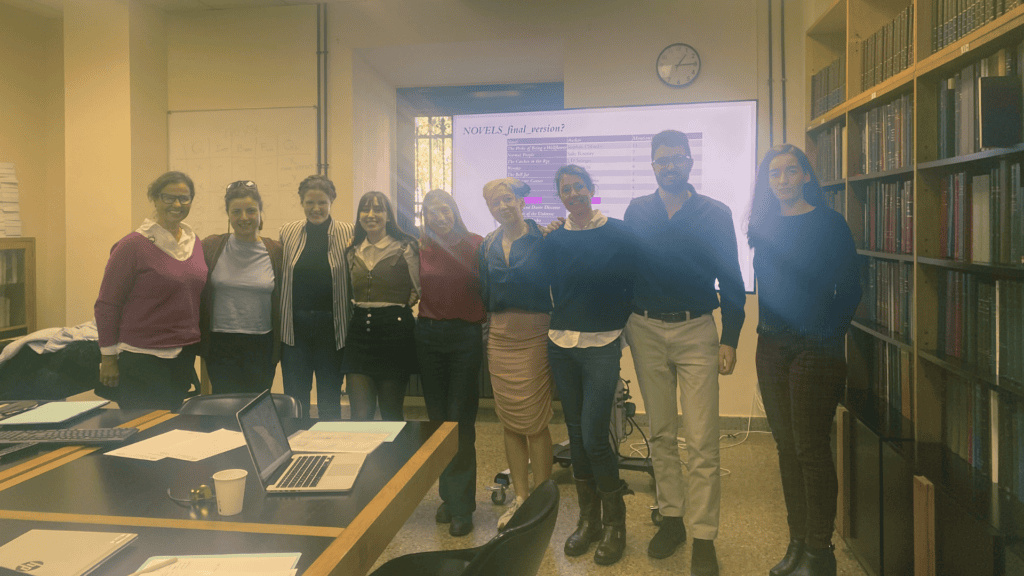
Victoria’s Presentation: The power of fiction in promoting positive social outcomes
Victoria presented a short overview on her previous study with “An empirical study of fictional abuse narratives & prosocial reader outcomes using storyworld possible selves”, co-authored with Ailise Bulfin, CSAReps’ Principal Investigator and María-Ángeles Martínez, the creator of the SPS theory, which looked into:
– whether exposure to abuse-themed fiction activates readers’ SPSs,
– whether this leads to measurable prosocial effects, and
– whether certain SPSs are connected to certain prosocial effects (such as increased empathy for real-world abuse victims, expression of thoughts about child protection, or reinforced accurate knowledge about CSA).
It is the first study to test correlations between SPSs emergence and prosocial effects, and also the first to link SPS measures to other engagement-measures, such as Character liking, Text liking, and Identification. It used a fine-grained classification of SPSs found in the reader responses, thus being true to the original formulation of SPS theory by María-Ángeles Martínez, that included self-concept (self-schema, desired, undesired, past self, and past SPSs), narrative entity, and the type of blending process.
To inform the planned research in the NEST project, the presentation then highlighted what worked well in this study and what had proved complicated, focusing on selecting appropriate literary material, the coding of open-ended questions using an intercoder design, and the choice of correlations with other engagement measures and prosocial effects studied.
The next step: A new research project about the therapeutic effects from stories
The NEST team and the advisory board then discussed the planned study design on the potentially therapeutic effects of reading literature and watching films on social anxiety, taking into account the learnings from Victoria’s and Emily’s presentations on prior work on SPSs and empirical studies.
Together, a preliminary design for the study was developed in a very lively and fruitful discussion.
In the upcoming choice of literary and filmic work to be used in the study, the team will draw on the results of a survey conducted by Rocío Riestra-Camacho of the NEST team in which participants named works that they thought dealt with the topic of social anxiety.
After establishing a preliminary corpus based on the survey, the NEST project core team will read/view the selected works, and evaluate them using a structured scoring system based on criteria adapted from our framework presented in the article “‘I don’t know why this most horrible part comes up to me now…’: A Framework for Linking Textual Dimensions of Child
Sexual Abuse Fiction to Reader Response.”
The main dimensions guiding this assessment will include:
– Centrality of social anxiety within the narrative
– Explicitness of its depiction
– Perspective and focalization (i.e., whether the narrative centres on the individual experiencing social anxiety)
These dimensions will be operationalized using a rating scale (1-5), enabling the NEST team to identify works that receive consistently high scores across multiple raters.
Why it matters for future research
The use of our framework in this way demonstrates its methodological adaptability and relevance beyond research on CSA for other (empirical media) scholars:
– Adaptability: The dimensions were originally developed with the explicit aim of being adaptable to other topics beyond CSA, and the NEST project’s application to social anxiety confirms this intended broader usability in a new research context;
– Multimedia: While used by us only in the contexts of novels, the dimensions used in this new context shows that they can function effectively across different fictional media, including both literature and film
– Practical: Their clearly defined structure allows straightforward transformation into a quantitative rating instrument.
By blending literary theory with mental health research, the NEST project is unlocking new, creative ways for potential positive therapeutic effects of stories. We look forward to seeing how this framework can shape future therapies and help us to better understand social anxiety.
Written by Victoria Pöhls | Postdoctoral Researcher and Olivia Susilo | Research Assistant