
Reflections on EROL, Zagreb (1–2 September)

I had the pleasure of attending the Everyday Reading of Literature (EROL) conference at the University of Zagreb on the 1st and 2nd of September of 2025, which was very interesting, inspiring and energising. The conference was organised by the research team on the Remembering Literature in Everyday Life (ReLEL, or PoKUS in Croatian) project, which is funded by the Croatian Science Foundation. The ReLEL team members are Lovro Škopljanac (PI), Velna Rončević and Luka Ostojić. The two days were filled with thought-provoking presentations, engaging conversations, and the kind of exchange that reminds me why I love being part of this project.
Keynotes and Sessions
The keynotes were a highlight in themselves. Rita Felski’s talk on Expert Readers / Amateur Readers was a real eye-opener, challenging the distinctions we so often take for granted between “serious” and “everyday” reading. She made a strong case for taking all reading practices seriously, and it set the tone beautifully for the conference.
At the other end of the programme, Astrid Erll’s keynote on Memory Studies in Search of the Reader tied together many of the themes we had been exploring, emphasising the reader’s role in sustaining cultural memory.
In between, the sessions offered a rich mix of topics. Several papers spoke directly to the reading of trauma in memoir and fiction, particularly around experiences of disordered eating, sexuality and controversy, I attended the below presentations:
- DeNel Rehberg Sedo examined memoir and social media, showing how life writing intersects with digital spaces of remembering.
- Martina Domines analysed memoirs of eating disorders (Wasted by Marya Hornbacher and Elena Vanishing by Elena and Claire Dunkle), drawing attention to the intimate ways trauma is narrated on the page.
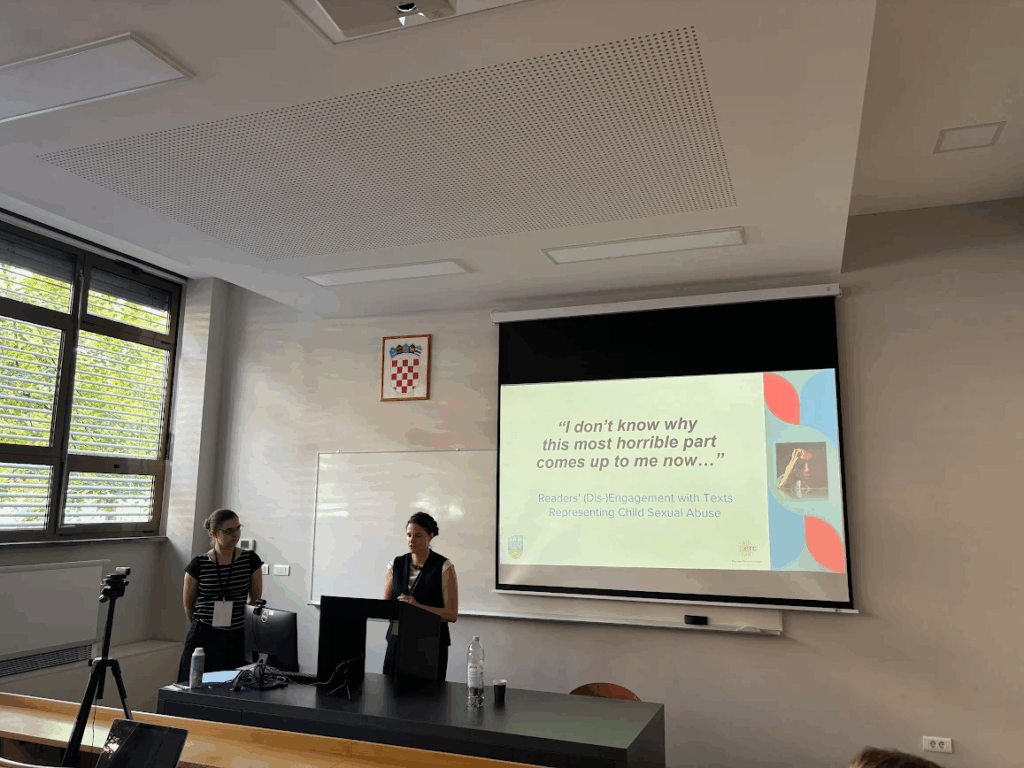
- Victoria Pöhls (Postdoc) and Aleksandra Milenović (Research Assistant) from our CSAReps team (see below) extended this concern with trauma by exploring how readers respond to texts representing CSA.
- Martina Domines’ papers also particularly resonated, showing how trauma narratives both demand and resist engagement from readers.
Other sessions widened the lens to questions of empathy, identity, and cultural context:
- Antonia Vogler on pronouns and perspective-taking in shared reading groups;
- Julija Ovsec and Moniek Kuijpers on reader emotions and digital practices;
- Anna Murashova on online reading in Russia;
- Guido Bartolini on complicity in WWII fiction;
- Antonia Došen on Jewish family reading habits in Zagreb;
- Ave Palm on queer tragedy and affective responses;
- Carrie Timlin, Robin-M. Aust, and Colette Gordon on figures as varied as Virginia Woolf, Thomas Bernhard, and the early modern playtext.
A Personal Highlight: Victoria Pöhls and Aleksandra Milenović CSAReps Project: Representations of CSA in Everyday Reading
Our team’s paper concerned how readers encounter representations of child sexual abuse (CSA) in literature. CSA is a critical global issue, affecting an estimated one in eight children worldwide, yet it remains a socially taboo subject. Despite this cultural silence, CSA features prominently in literary fiction and autobiographical writing, shaping how both victim/survivors and the wider public understand the issue.
Using the dataset created by the PoKUS team, Victoria Pöhls and Aleksandra Milenović presented a study that explored how Croatian readers spontaneously discuss CSA when reflecting on self-chosen books from their everyday reading. Drawing on a rich corpus of over 1,000 interviews, they identified 29 books that mentioned or alluded to CSA, ranging from texts where CSA is central (Lolita, The Girl with the Dragon Tattoo, The Kite Runner) to works where it appears only peripherally (Game of Thrones).
The team investigated several questions: whether readers even brought up CSA unprompted; which aspects they chose to mention (the representation itself, graphic scenes, emotional responses, or broader reflections); and how they spoke about the subject — explicitly or implicitly, or using language that sometimes hinted at discomfort. They also analysed whether readers responded with empathy towards victim/survivors or, on the other hand, reproduced harmful myths such as victim-blaming.
Some participants reported powerful and mixed emotions that lingered long after the initial reading, while others offered “lessons learnt” that connected the fictional texts to lived experience or societal issues. The study also showed that the way CSA is represented — whether central or peripheral, detailed or implicit — shaped how readers remembered and responded to it.
This research was not only methodologically innovative, using the organically compelling PoKUS corpus, but also significant. It demonstrated how literature can open space for readers to engage with “difficult topics” that are otherwise silenced in everyday discourse. Their findings point to the potential of fiction and memoir to challenge social avoidance and to correct harmful preconceptions about CSA — or, conversely, to reinforce them depending on how the narrative is framed.
For me, this presentation was a highlight of EROL: my colleagues on my team, careful, sensitive, and deeply humane. It showed how scholarship can clarify the complex ways in which reading intersects with trauma, memory, and ethics — and why this area of study is so important. The full paper based on this talk will be available as part of the EROL conference proceedings in 2026.
The Atmosphere in Zagreb
Beyond the sessions themselves, what made EROL so memorable was the sense of community and the great conversations with kind, caring, thoughtful, energic academics from all corners of the world and wonderful engaging conversations over dinner. Zagreb itself provided a wonderful backdrop — welcoming, lively, and full of history. Pleasant weather, charming people and a beautiful city.
Closing Thoughts
Attending EROL reminded me of the richness and diversity of reading practices. Every paper offered a different window into the ways literature touches lives, whether through personal memory, historical context, or digital platforms. I left feeling assured that the study of reading is not only intellectually comprehensive but also profoundly individual.
I particularly want to read Patrick Stewart’s “Making it so” Memoirsmemoir, well, listen to it narrated by his lovely voice. I would also go back to Zagreb just to go to Boban Restaurant again.
CSAReps Project – Abstract below (photos also)
“I don’t know why that most horrible part comes up to me now” – Readers (Dis)Engagement with Texts representing Child Sexual Abuse Reading can be a way of engaging with so-called ‘difficult topics’ usually avoided (Menninghaus et al. 2017). One such issue is child sexual abuse (CSA): Despite being a critical issue affecting one-in-eight children worldwide (Sanjeevi et al. 2018; European Commission 2024) with potentially grave mental and physical health consequences (Hailes et al. 2019), it remains a relatively taboo subject. Notwithstanding the social avoidance, CSA is widely represented in literary fiction and autobiographies, which may also affect victim-survivors’ and wider public understandings of the issue. Can engaging with (fictional) representations in the ‘safe space’ of books at least partly counteract the societal flinch and correct harmful preconceptions about CSA? To date, research into how fiction representing CSA affects audiences who spontaneously come across CSA as part of their everyday reading is very limited. Therefore, we collaborated with the PoKUS team to investigate mentions of texts representing CSA in their corpus of 1005 Croatian readers discussing self-chosen books. An initial corpus review resulted in the identification of 29 books mentioning or alluding to CSA. These range from works where CSA is a central theme (e.g., Nabokov’s “Lolita”), to those where it is integral to the character’s backstory or a driving force in the plot (e.g., Larsson’s “The Girl with the Dragon Tattoo” or Hosseini’s “The Kite Runner”), or where CSA is merely a peripheral element (e.g., Martin’s “Game of Thrones”). First, we tried to ascertain whether respondents, unprompted by the interviewers, would mention CSA at all when discussing their reading experiences (RQ1), expecting that this would vary according to the topic’s prominence within the book. Second, we explored what aspects of CSA were mentioned (RQ2): Did readers focus on the fact of representation itself, on graphic scenes, on their own (emotional) reaction to the depiction, or did they offer thoughts that went beyond the reading, relating the story to life experiences or societal consequences? A qualitative thematic analysis revealed that strong and mixed emotional responses occurred only in some participants, but they were remembered even after a significant amount of time had passed since the initial reading. Notably, respondents volunteered very different kinds of ‘lessons learnt’. Thirdly, we focused on the way CSA was discussed by respondents (RQ3) and analyzed the terms used to describe CSA as well as subvocal expressions and pauses potentially hinting at discomfort in talking about this theme. Lastly, we considered whether participants adopted a victim-survivor-centred perspective when discussing the books, or whether they instead endorsed variations of harmful CSA myths (Glina et al. 2022), e.g. victim blaming (RQ4). We will relate our findings to the representation in the specific book to provide an indication of whether authorial ways of representing CSA can be connected to readers’ perception of it and whether there is any evidence of the texts helping overcome the flinch. These analyses, grounded in the ecologically-valid PoKUS corpus, will help us to gain a deeper comprehension of the impact of (specific) representations on actual readers, informing future research in this area.
Bibliography:
European Commission. Protecting children from sexual abuse. Fialho, Olivia. 2024.
Transformative reading. John Benjamins. 7 Nov 2024.
F., et al. 2022. “Lay People’s Myths Regarding Pedophilia and Child Sexual Abuse: A Systematic Review.” Sexual medicine reviews 10(4): 596-619.
Green, Melanie and Markus Appel. 2024. Narrative Transportation: How Stories Shape How We See Ourselves and the World. Advances in Experimental Social Psychology. 70: 1-82.
Koopman, Emy, Michelle Hilscher & Gerald Cupchik. 2012. Reader responses to literary depictions of rape. Psychology of Aesthetics, Creativity, and the Arts 6(1). 66–73.
Kuiken, Don, & Paul Sopčák. 2021. Openness, Reflective Engagement, and Self-Altering Literary Reading. In Don Kuiken & Arthur Jacobs (eds), Handbook of Empirical Literary Studies, 305-31.
Berlin: De Gruyter. Loi, Cristina, Frank Hakemulder, Moniek Kujpers & Gerhard Lauer. 2023. On how fiction impacts the self: Transformative reading experiences and storyworld possible selves. Scientific Study of Literature 12(1). 44-67.
Menninghaus, W., Wagner, V., Hanich, J., Wassiliwizky, E., Jacobsen, T., & Koelsch, S. (2017). The distancing-embracing model of the enjoyment of negative emotions in art reception. Behavioral and Brain Sciences, 40, e347.
Sanjeevi, Jerusha, Daniel Houlihan, Kelly Bergstrom, Moses Langley & Jaxson Judkin. 2018. A Review of Child Sexual Abuse: Impact, Risk, and Resilience in the Context of Culture. Journal of Child Sexual Abuse 27(6). 622-41.