
“We won’t end child sexual abuse if we don’t look at the root causes… (and how fiction may help us with that)” with Reggie Noto
Interviewed by Olivia Susilo – recorded on the 30th June 2026. Edited with permission from the speaker.
Reggie Noto is the Senior Advisor for Primary Prevention at Traverse Bay Children’s Advocacy Centre in Michigan, who does incredible work with a talented team in designing, implementing, and measuring initiatives for preventing child sexual abuse. Reggie’s focus is on primary prevention within the community, and she has used fiction and the arts in general as part of that effort.
In this episode, we discussed many things, such as:
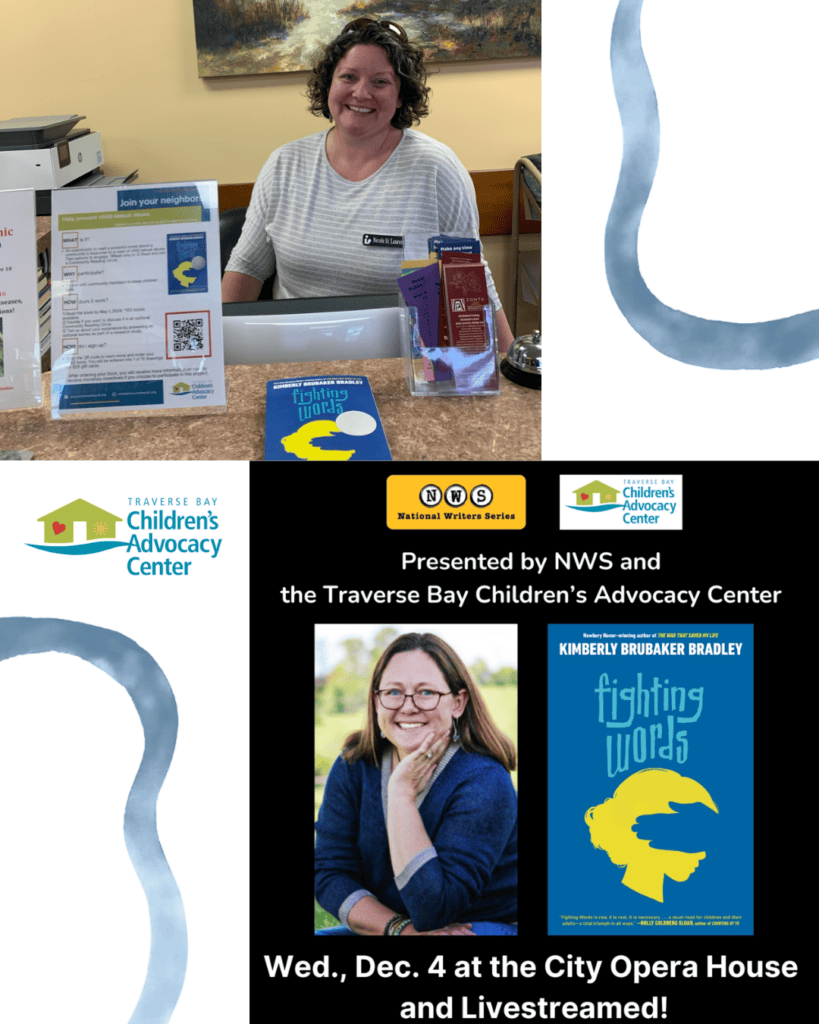
- The Fighting Words Reading Circle: Organizing a community Reading Circle to reflect on Fighting Words, which is a fictional children’s book by Kimberly Brubaker Bradley with child sexual abuse representation.
- Creative Collaboration with MSU: Working with Professor Ross Chowles, a Professor of Advertising at Michigan State University and university students at Advanced Creative Advertising classes to produce public service announcements to prevent child sexual abuse.
- CSA Prevention and Fiction: Reggie’s perspective on the role of fiction in CSA primary prevention.
- Local Eats: Reggie’s favorite food recommendations.
Listen to the recording by clicking on the link below:
Alternatively, listen to the recording on our Spotify below:
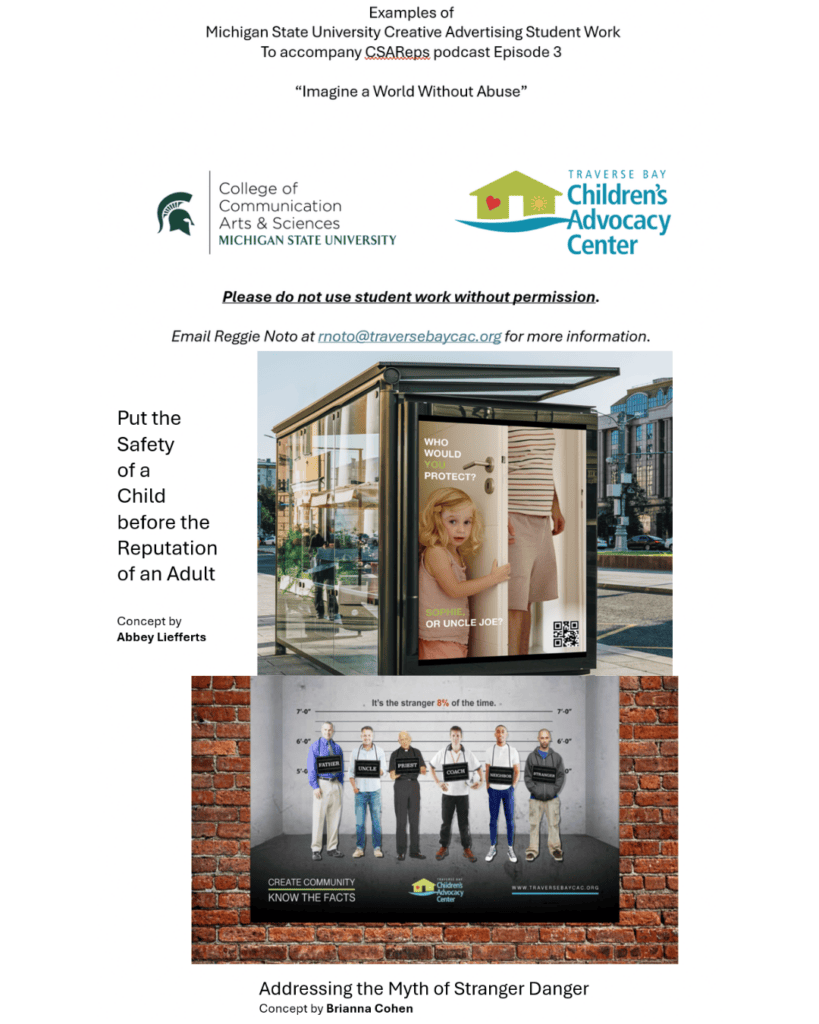
Click here to see more examples of the student work on “Imagine a World Without Abuse”.
References mentioned:
Assini-Meytin L. C., McPhail I., Sun Y., Mathews B., Kaufman K. L., Letourneau E. J. (2025). Child sexual abuse and boundary violating behaviors in youth serving organizations: National prevalence and distribution by organizational type. Child Maltreatment, 30(3), 499–511. https://doi.org/10.1177/10775595241290765
Australian Institute of Family Studies. What is an evidence-informed approach to practice and why is it important? https://aifs.gov.au/resources/short-articles/what-evidence-informed-approach-practice-and-why-it-important
Bailey, S., (2024, June 25). We Cannot Arrest Our Way Out of the Problem: The Importance of a Whole System Approach to Tackling Child Sexual Abuse [Keynote address]. Envision: The Future of Prevention Conference, Moore Center, Bloomberg School of Public Health, Johns Hopkins University, Washington DC, United States.
Bell, L. A., & Desai, D. (2011). Imagining otherwise: Connecting the arts and social justice to envision and act for change: Special issue introduction. Equity & Excellence in Education, 44(3), 287-295. https://www.researchgate.net/publication/232999761_Imagining_Otherwise_Connecting_the_Arts_and_Social_Justice_to_Envision_and_Act_for_Change_Special_Issue_Introduction
Berkowitz, A., Bogen, K.W., Meza Lopez, R.J., Mulla, M.M. & Orchowski, L.M. (2022) The Social Norms Approach as a Strategy to Prevent Violence Perpetrated by Men and Boys: A Review of the Literature, Chapter 7 in Engaging Boys and Men in Sexual Assault Prevention; Elsevier Inc. https://www.alanberkowitz.com/articles/Social%20Norms%20and%20Violence%20Literature%20Review%20July%202020.pdf
Bright, M.A., Ingram, M., Bodi, C., & Finkelhor, D. (April 2026) Nonconsensual sexual behavior among youth: Age dynamics and implications for prevention. Child Abuse & Neglect. Volume 176, 108030, https://doi.org/10.1016/j.chiabu.2026.108030
Bulfin, Ailise. (2025). Investigating Fictional Representations of Child Sexual Abuse in Contemporary Culture: Myths and Understandings. CSAReps@ucd.ie.
Buller, A.M., Pichon, M., McAlpine, A., Cislaghi, B., Heise, L., & Meiksin, R. (2020) Systematic review of social norms, attitudes, and factual beliefs linked to the sexual exploitation of children and adolescents, Child Abuse & Neglect, Volume 104, 104471, https://doi.org/10.1016/j.chiabu.2020.104471.
Chittum, J. R., Enke, K. A. E., & Finley, A. P. (2022). The effects of community-based and civic engagement in higher education. American Association of Colleges and Universities. https://www.aacu.org/research/the-effects-of-community-based-engagement-in-higher-education
Hembroff, L.A., Martell, D., Allen, R., Poole, A., Clark, K., & Smith, S.W. (2019). The long-term effectiveness of a social norming campaign to reduce high-risk drinking: The Michigan State University experience, 2000–2014, Journal of American College Health, DOI: 10.1080/07448481.2019.1674856
HOPE Healthy Outcomes from Positive Experiences. (2025). https://positiveexperience.org/
Klika, J.B., Haboush-Deloye, A., & Linkenbach, J. (2019). Hidden protections: Identifying social norms associated with child abuse, sexual abuse, and neglect. Child & Adolescent Social Work Journal, 36(1), 5-14. https://oasis.library.unlv.edu/community_health_sciences_fac_articles/287/
Kuh, George. (2008) High Impact Educational Practices: What They Are, Who Has Access to Them and Why They Matter. American Association of Colleges and Universities. ISBN: 978-0-9796181-4-7.
Lilleston, P.S., Goldmann, L., Verma, R.K., & McCleary-Sills, J. (2017) Understanding social norms and violence in childhood: theoretical underpinnings and strategies for intervention. Psychology, Health & Medicine, Vol. 22, No @1, 122-134. http://dx.doi.org/10.1080/13548506.2016.1271954
National Social Norms Center. Michigan State University. https://socialnorms.org/.
Tankard, M. E., Paluck, E. L. (2016) Norm Perception as a Vehicle for Social Change. Social Issues and Policy Review, 10(1), 181-211. https://doi.org/10.1111/sipr.12022
Tijsma, G., Hilverda, F., Scheffelaar, A., Alders, S., Schoonmade, L. J., Blignaut, N., & Zweekhorst, M. (2020) Becoming productive 21st century citizens: A systematic review uncovering design principles for integrating community service learning into higher education courses. Educational Research, 62(4), 390 413. https://doi.org/10.1080/00131881.2020.1836987