
CSAReps’ April Fiction Club

Reflecting on “Monsters: The Lyle and Erik Menendez Story”
On Wednesday, April 29th, 2026, the CSAReps team hosted its latest Fiction Club meeting.
The CSAReps Fiction Club is a regular initiative organized by CSAReps project team members. As part of the research framework, team members analyze various fictional works that address the experiences of child sexual abuse (CSA). Because engaging with these heavy narratives individually can be distressing, the team regularly organizes “Shared Watching” and “Shared Reading” sessions through the Fiction Club events. These events transform a potentially isolating task into a collaborative group discussion – and have been recently warmly opened to members of the University College Dublin community.
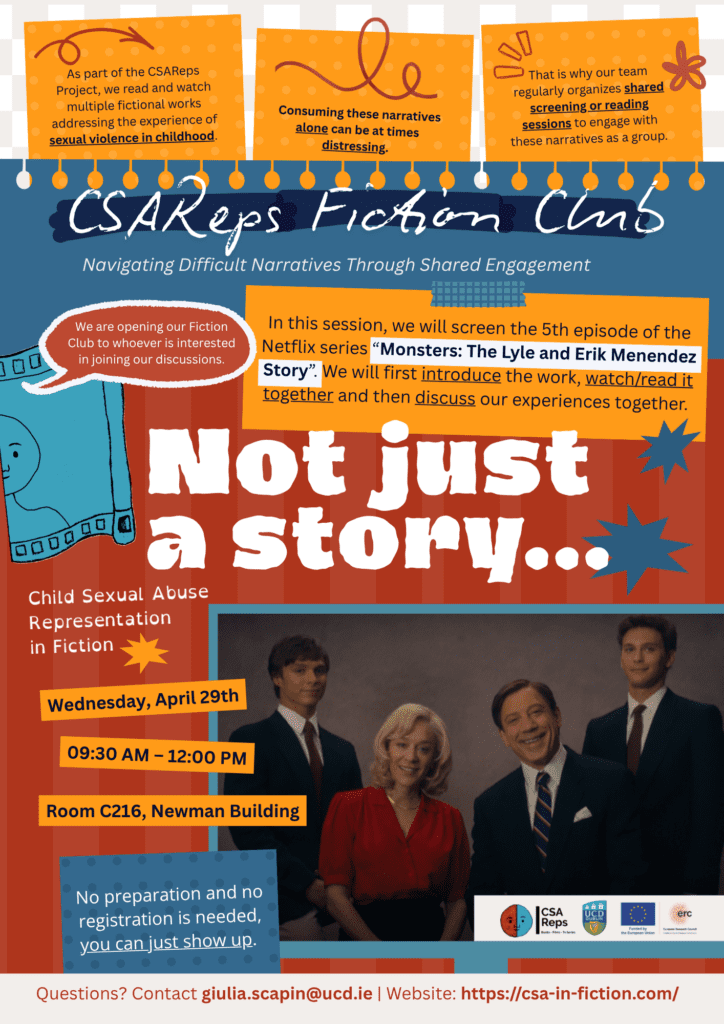
For this session, the CSAReps team screened the fifth episode of the 2022 Netflix series Monsters: The Lyle and Erik Menendez Story, created by Ryan Murphy and Ian Brennan. It is a dramatization based on the real-life case of the Menendez brothers. The event began with an introduction to the series and the specific episode, followed by a group screening and an open, collaborative discussion.
The screening sparked several thoughtful reflections from the attendees regarding how media portrays the complexities of CSA, for instance:
1. Metaphors as a Tool for Articulating Trauma
The discussion highlighted how metaphors can serve as a powerful tool for survivors to communicate their experience of CSA. In the episode, Erik initially struggles to find the words to describe the abuse he received, relying heavily on ambiguous words like “it” to avoid explicitly saying words like “sex” or “penis.” However, he is able to speak far more freely when prompted with a metaphor, describing his family dynamic as an “octopus” with tentacles that were constantly reaching out to trap him. This suggests how metaphoric language can help to overcome psychological barriers when literal descriptions feel too overwhelming.
2. The Duality of the “Love-Hate” Relationship in Abuse
Attendees also reflected on the confusing and painful dualities seen in familial abuse. Erik recounts that while his father frequently hit him and used derogatory slurs, the dynamic shifted drastically during some acts of CSA. In those moments, his father would praise him, for example by telling him he was a “good boy.” Erik tragically notes that those moments felt like the only time he had a “real relationship” with his father – confusing exploitation with affection. This highlights the emotional complexity survivors can face when abuse is deeply connected with a need for parental love and validation.
3. Cinematic Technique: The Power of the Single Shot
Another point of discussion was the episode’s striking technical execution of a single and consistent camera shot. As viewers, we initially sit directly across the table from Erik, positioned next to his defense attorney, Leslie. Over the course of the episode, the camera slowly tightens into a close-up, making the audience focus entirely on Erik’s expressions and words.
This gradual cinematic movement serves as a powerful mirror to the CSA experience itself. Just as the camera subtly closes in until nothing else is visible, Erik’s abuse began gradually from “it didn’t start bad” until, without realizing it, the trauma became his entire, inescapable reality.
However, the discussion also touched on the potentially harmful aspects of the series. While the episode provides deep insight into the CSA survivor’s experience, some attendees noted that the show seem to prioritizes dramatization. Specifically, the attendees critiqued the choice of ‘Monsters’ as a title and the narrative in framing the brothers’ disclosures through a lens of public doubt. Attendees reflected on how these creative choices risk turning trauma into entertainment, potentially reinforcing harmful patterns of questioning a CSA survivor’s truth, rather than listening to their story.
Here is what one of our attendees reflected on this matter:
“However, despite the sensitivity and victim-survivor centeredness of the episode, which may be meaningful to victim-survivors and give some insight for the wider public into the ways grooming can manipulate and entrap a child, the episode still casts doubt on the veracity of Erik’s disclosure. At a key moment after the bulk of Erik’s account, Leslie, the defence lawyer, opines that ‘if what you are telling me is true, and if what Lyle said is true’ then they deserved better parents. By using the veracity of the brothers’ disclosures as the series hook, the narrative reinforces the ‘false accusation’ sexual violence myth that victims lie in a dangerous way for entertainment value. And it does so very skilfully – I found myself trying to work this out based on the ‘evidence’ the docudrama was presenting & then was annoyed with myself for falling into this trap.”
Overall, the Fiction Club session offered attendees a deeper understanding of how modern media can capture how survivors could perceive and experience the trauma of CSA. This discussion provides a shared analysis of how we can better understand both the impactful storytelling and the experience faced by CSA survivors.
Written by Maria Olivia Susilo | Research Assistant