
CSAReps’ May Fiction Club: Reflecting on “Law and Order Special Victims Unit SVU”
On Wednesday, May 27th, 2026, the CSAReps team hosted its latest Fiction Club meeting.
The CSAReps Fiction Club is a regular initiative organized by CSAReps project team members. As part of the research framework, team members analyze various fictional works that address the experiences of Child Sexual Abuse (CSA). Because engaging with these often heavy narratives individually can be distressing, the team regularly organizes “Shared Watching” and “Shared Reading” sessions through the Fiction Club events. These events transform a potentially isolating task into a collaborative group discussion – and have been recently warmly opened to members of the University College Dublin community.
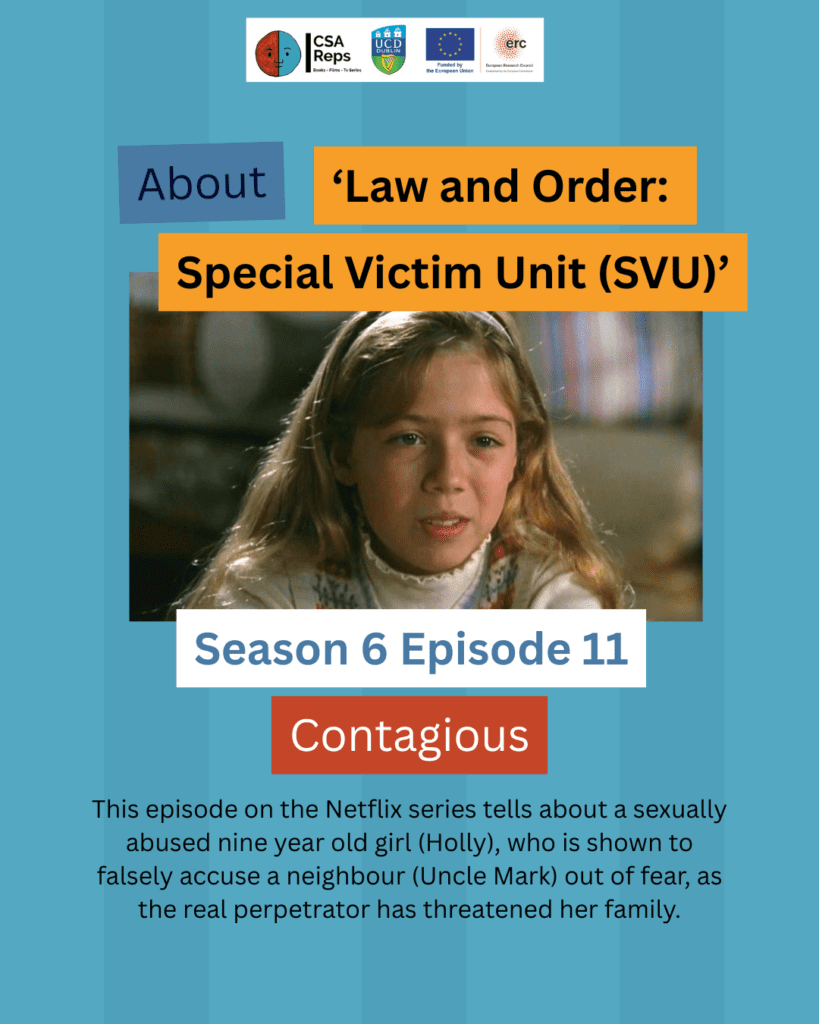
For this session, the CSAReps team watched an episode of a popular fictional drama series, “Law and Order Special Victims Unit (SVU)” about a New York Police Department (NYPD) team which solves crimes relating to harassment and sexual violence. Specifically, the Fiction Club screened the eleventh episode of the sixth season of “Law and Order SVU” (2025), titled “Contagious”, written by Jonathan Greene and directed by Aaron Lipstadt.
What we think about it
The event began with an introduction to the series and the specific episode, followed by a group screening and an open, collaborative discussion.
The screening itself sparked several thoughtful reflections from the attendees regarding how media portrays the complexities of CSA, for instance:
1. The Impact of the False Accusation
This episode is about a sexually abused nine year old girl (Holly), who is shown to falsely accuse a neighbour (Uncle Mark) out of fear, as the real perpetrator has threatened her family. When news of this leaks out, two more girls come forward and name the same perpetrator. Ultimately, all three are revealed to be lying – the first to protect her family and the latter two as a result of their mothers’ “contagious hysteria”. The grave effects on the falsely accused Uncle Mark and his family are emphasised – he loses his job and he and his wife move town.
In this episode, the audience can see how false accusations can quickly ruin someone’s life. Even though he is proven innocent later on, the social damage is already done. However, although the narrative is strongly sympathetic to the survivor, this focus on false accusations and their harmful effects on the falsely accused may convey to the audience that victims frequently lie, confirming the entrenched CSA myth that false accusations are common.
2. Support For the Survivor
A major theme in this episode is how much almost everyone believes and supports the child survivor, Holly. From the very beginning, the detectives never doubt her story. They focus entirely on helping her and finding the real abuser.
Eventually, many local community members (e.g., doctors, nurses, and teachers) get involved to help look for the perpetrator. While this makes for a reassuring TV show where the community acts like a protective shield for the survivors, unfortunately, it can often be very different compared to what real-life survivors experience, where they might face disbelief or judgment from the people around them.
3. The Ethical Issue of Support Professionals
We believe that one of the climaxes of the episode highlights an ethical issue with how support professionals handle child survivors, especially when they are talking or asking about the CSA. Before the interview investigation, the psychologists and police promise the parents that Holly is in control and can stop the interview whenever she feels uncomfortable.
However, as soon as they get close to finding out the truth, they break that promise. When Holly panics and wants to stop, they push her anyway, saying things like “just a little longer” and demandingly asking “who is it, Holly? WHO IS IT?” It seems that they choose getting information to solve the case over the immediate comfort and mental well-being of the child.
Overall, the team believes that this episode highlights a contradiction in how TV series can show the justice system in helping child survivors. On one hand, it shows a highly supportive environment where the police and the community fully believe the child. On the other hand, it reveals how easily an innocent person’s life can be disrupted by a false accusation, and how the system will ultimately push a traumatized child past her boundaries (“just a little longer”) to close a case. It shows an example of how people can seem to be survivor-centered, while still putting pressure on the survivors.
Written by Dr. Ailise Bulfin, Dr. Giulia Scapin, Victoria Pöhls, Caroline Dunne, and Maria Olivia Susilo